Got
Questions?
Browse our frequently asked questions below to learn more about our flight training programs, admissions process, and what to expect.
Search All FAQs
Use the search bar below to find answers across all of our programs and categories.
An FAA Part 145 Repair Station is a facility certified by the Federal Aviation Administration to perform maintenance, preventive maintenance, and repairs on aircraft. This certification signifies adherence to strict regulatory standards, quality control, and use of qualified personnel. Learn more in our complete guide.
In-house maintenance significantly reduces training delays by ensuring faster repairs and greater control over aircraft availability. This allows for more consistent scheduling, which is crucial for accelerated programs and helps you complete your certifications more quickly.
Yes, USATS operates an FAA Part 145 Repair Station on-site, where our certified technicians perform maintenance on our entire fleet of training aircraft, including both fixed-wing airplanes and helicopters.
Our in-house FAA Part 145 Repair Station maintains our full fleet, which includes modern fixed-wing aircraft like Cessna 172s with G1000 glass cockpits and Alto NGs, as well as rotorcraft such as Robinson R44s and Schweizer S300s.
Our dedicated in-house maintenance team is fully equipped to service our helicopter fleet. This ensures that students in our helicopter flight training programs have access to safe, reliable, and consistently available aircraft for their lessons.
Our in-house FAA Part 145 Repair Station is a significant factor contributing to our reputation. It ensures operational efficiency, safety, and consistent aircraft availability, which are key advantages for students choosing among aviation schools in Florida.
You must be at least 16 years old to solo and hold a valid student pilot certificate along with a medical certificate.
Program duration varies depending on whether you train full-time or part-time, typically ranging from 6 to 12 months.
You must obtain at least a third-class FAA medical certificate from an authorized Aviation Medical Examiner (AME). It's wise to get this done early to ensure you have no underlying health conditions that could prevent you from flying. Learn more about the medical exam process in our guide: Preparing for Your First FAA Medical Exam.
The FAA requires a minimum of 40 flight hours for a helicopter PPL under Part 61, which includes at least 20 hours with an instructor and 10 hours of solo flight. Part 141 programs, like those at USATS, have a minimum of 35 hours and offer a more structured curriculum. Most students take between 50-60 hours to become proficient.
Yes, it's called an 'add-on' rating. The training requirements are reduced, and you won't need to retake the written knowledge test. USATS offers specific programs for fixed-wing pilots looking to add a rotorcraft rating. Explore our Helicopter Add-On Programs.
Florida offers over 300 flyable days per year, which means fewer training delays and more consistent progress toward your license. The state's diverse airspace and robust aviation infrastructure make it an ideal place to learn to fly. Discover more reasons in our post: Why Florida’s Space Coast is Ideal for Flight Training.
You must be at least 16 years old to solo a helicopter and 17 to receive your private pilot certificate.
Earning your helicopter PPL involves ground school to build foundational knowledge (aerodynamics, regulations, weather) and hands-on flight training covering basic maneuvers, advanced maneuvers, cross-country flying, and solo flights. The final step is a practical test, known as the 'checkride'.
The timeline depends on your commitment. Full-time students training several times a week could potentially earn their helicopter PPL in 3 to 5 months. Part-time students typically take 6 to 9 months. Consistency in training is key to efficient completion.
Yes, USATS offers structured FAA Part 141 programs for helicopter training, which ensure you cover all necessary knowledge and skills efficiently and can often lead to completion in fewer hours than Part 61 training.
Yes, international students have additional requirements, including securing an M-1 student visa and completing TSA approvals. USATS has extensive experience supporting international students through this process. Learn more on our International Student Training page.
Your pilot certificate is the credential itself: student, private, commercial or airline transport pilot (ATP). A rating is a line on that certificate that says what you can fly and how, such as the rotorcraft category, the helicopter class or an instrument-helicopter rating. "License" is the everyday word for the certificate, and endorsements are something else again: instructor sign-offs in your logbook, like a solo or flight review endorsement. If you fly for fun, a private certificate with a rotorcraft-helicopter rating may be all you need, while a career path adds an instrument rating, a commercial certificate and instructor certificates. Our instructors show you which line goes on your certificate at each step, from first hover to instructor.
A private certificate lets you fly helicopters for fun and carry passengers, as long as nobody pays you for the flight. You can split fuel, oil, airport fees or rental with your passengers if you pay at least your equal share. A commercial certificate lets you be paid to fly and to carry people or cargo for hire, though operators set their own hiring minimums. Teaching takes a separate flight instructor certificate (CFI), which in helicopters requires a commercial or ATP certificate first, and the ATP is the highest pilot certificate. For the full side-by-side, read Private vs Commercial Helicopter License in 2026, or ask our admissions team to match a certificate to your goal.
Every helicopter pilot certificate carries the rotorcraft category and helicopter class rating. Many pilots later add an instrument-helicopter rating so they can fly in clouds and low visibility under instrument flight rules (IFR). Larger helicopters, over 12,500 pounds maximum takeoff weight, also need a type rating for that specific model. Instructor ratings (CFI and CFII) go on a separate flight instructor certificate. If you are not sure which ratings your goal calls for, read Which Helicopter License Do You Need for Your Goal in 2026? and then talk it through with our team.
No. FAA pilot certificates are issued without an expiration date, so your helicopter certificate stays valid unless it is surrendered, suspended or revoked (14 CFR 61.19). Your ability to use it is what runs on a clock: you need a current medical, a flight review every 24 calendar months, and recent takeoffs and landings before you carry passengers. A pilot coming back after years away still holds the certificate and only needs to get current again. Our instructors can build that refresher around the flying you plan to do.
You need a flight review every 24 calendar months to act as pilot in command (14 CFR 61.56). It includes at least 1 hour of ground training and 1 hour of flight training with an authorized instructor, covers the current Part 91 operating rules and the maneuvers your instructor chooses, and ends with a logbook endorsement. Many pilots still call it a BFR (biennial flight review). Passing a checkride for a new certificate or rating inside that window counts in place of a flight review, and so does completing a phase of an FAA-sponsored pilot proficiency program. We offer flight reviews for helicopter and airplane pilots, tailored to the flying you do.
It depends on the class and on your age on the exam date, and each period runs to the end of the month (14 CFR 61.23). A third-class medical, the one private pilots use, lasts 60 calendar months if you were under 40 at the exam and 24 calendar months if you were 40 or older. A second-class medical covers commercial flying for 12 calendar months, and a first-class medical covers ATP pilot-in-command flying for 12 months if you were under 40 at the exam and 6 months if you were 40 or older. When those shorter windows end, the same medical keeps covering private-level flying for the rest of the third-class period. For any health question, an Aviation Medical Examiner (AME) can tell you where you stand, and our team can help you time the exam around your training.
Your pilot certificate stays valid, but you cannot use the privileges that need that medical until an AME issues a new one. A commercial pilot whose 12-month second-class window has closed can still fly as a private pilot while the medical is inside its third-class window (60 or 24 calendar months, depending on age). Once the new medical is issued, those privileges return, provided your flight review and recent experience are also current. If you have been away from flying for a while, we can pair your return with a flight review so you come back fully current.
To carry passengers as pilot in command, you need three takeoffs and three landings in a helicopter within the preceding 90 days, flown as the sole manipulator of the controls (14 CFR 61.57). For passengers at night, from 1 hour after sunset to 1 hour before sunrise, those three takeoffs and three landings must be made to a full stop during that night period. If you fall out of currency, you can fly the takeoffs and landings with no passengers aboard to get current again. With a current medical and flight review on top of that, you are ready to share a flight along the Indian River with a friend. If it has been a while, a session with one of our instructors is a good way to shake off the rust first.
To fly under instrument flight rules (IFR), you must have logged six instrument approaches, holding procedures, and intercepting and tracking courses within the 6 calendar months before the month of the flight (14 CFR 61.57). If you go more than six further calendar months without meeting that requirement, the only way back is an instrument proficiency check (IPC). This matters most if you fly IFR or plan to, as helicopter air ambulance pilots do. A pilot who flies only in good weather under visual flight rules does not need it.
Yes. You add each rung one at a time, with its own training and checkride: the instrument-helicopter rating, the commercial certificate, the flight instructor certificate (CFI), the instrument instructor rating (CFII) and, at the top, the ATP. A pilot flying for fun may stop at private or add the instrument rating for an extra safety margin. A career path usually runs through commercial to CFI, where many new commercial helicopter pilots build their first paid hours. We train every helicopter rung from Private to ATP at Space Coast Regional Airport (KTIX) in the same S300 and R44 helicopters, so you can add each rating without changing schools.
Yes. Airplane goes on as a second category on the pilot certificate you already hold, and you do not take a second knowledge test at the same certificate level, though you still train for and pass an airplane checkride (14 CFR 61.63). The same rule works in the other direction for airplane pilots adding helicopters. Some pilots add it for career range, others for the fun of flying both. We train airplanes and helicopters at the same airport, so our admissions team can map out that plan with you. For a side-by-side of the two, read Helicopter License vs Airplane License in 2026.
Flight instructor certificates issued on or after December 1, 2024 have no expiration date. Older certificates still expire 24 calendar months after they were issued, renewed or reinstated (14 CFR 61.19). Either way, to keep teaching you must show recent instructor experience every 24 calendar months, for example by completing an approved flight instructor refresher course, passing a practical test for an instructor rating, or endorsing enough students for their checkrides (14 CFR 61.197). Our CFI-H program prepares you for the instructor checkride, and passing it also counts as your flight review.
Yes, within limits. The United States is a member of the International Civil Aviation Organization (ICAO), and FAA private, commercial and ATP certificates with a helicopter rating carry an English Proficient endorsement that meets ICAO's language standard for international flying. That lets you fly a U.S.-registered (N-registered) helicopter in other countries, as long as you follow each country's rules. To fly a helicopter registered in another country, or to work for an operator there, you generally need that country's own license or a validation of your FAA certificate, and each aviation authority sets its own process.
Yes. If you hold a pilot license from an ICAO member country, the FAA can issue a U.S. private pilot certificate based on your foreign license (14 CFR 61.75). It carries private privileges only, and it is valid only while your foreign license stays in effect and is with you or readily accessible in the aircraft. You also need to meet the English language requirement and hold a medical, either an FAA medical or one from the country that issued your license. Flying for pay in the U.S. takes a full FAA commercial certificate. We have trained pilots from more than 120 countries, and our foreign license conversion team guides you from FAA verification to checkride preparation.
The primary force that opposes gravity in flight is **lift**. It's an aerodynamic force generated by the motion of an airfoil (like a wing or rotor blade) through the air, allowing the aircraft to become airborne. You can learn more in our guide to understanding lift.
Airplane wings create lift primarily through two scientific principles: Bernoulli's Principle (lower pressure from faster airflow) and Newton's Third Law (the equal and opposite reaction to air being deflected downward).
In airplanes, lift is generated by fixed wings moving forward. In helicopters, lift is created by rotating main rotor blades. You can explore the differences in our airplane and helicopter training programs.
The four key factors that affect lift are the **angle of attack**, **airspeed**, **airfoil shape**, and **air density**. Our guide to advanced aerodynamics covers these in more detail.
A stall occurs when a wing exceeds its critical angle of attack, causing airflow to separate and lift to be drastically reduced. Stall recovery is a key part of the emergency procedures taught during flight training.
Understanding lift is crucial for mastering takeoffs, landings, and climbs. It is a fundamental part of our flight training programs and helps pilots make safe decisions.
USATS teaches lift through a combination of ground school, pre-flight briefings, hands-on flight training, and simulator practice. This approach is integrated into all our pilot programs to ensure a deep, practical understanding.
When budgeting how much does helicopter pilot training cost, the total investment depends on your target certification level, total flight hours required to reach proficiency, and the training aircraft selected. Key expense components include hourly aircraft rental, dual flight instruction, pre- and post-flight ground briefings, FAA written exams, and designated pilot examiner (DPE) checkride fees. Training in economical piston rotorcraft like our Schweizer S300 keeps hourly operating expenses lower for foundational maneuvers, while transitioning into the Robinson R44 prepares pilots for commercial performance demands. To understand exactly how much for helicopter pilot training your personalized schedule and goals will require, contact our admissions team for a detailed, transparent syllabus quote and aviation financing options.
Comparing how much is helicopter pilot training between Part 141 and Part 61 comes down to flight hour minimums and syllabus pacing. FAA Part 141 programs follow an FAA-audited curriculum with reduced flight hour minimums (35 hours for Private, 115 hours for Commercial), which can lower overall training expenditure for full-time students. Part 61 training requires 40 hours for Private and 150 hours for Commercial, offering maximum scheduling flexibility. In practice, students graduate once achieving practical proficiency, making consistency the biggest factor in managing costs. Learn more in our detailed Part 141 vs. Part 61 Helicopter Training Comparison.
A complete curriculum of training for helicopter pilot careers begins with the Private Pilot License (PPL) to master hovering and basic aerodynamics. Students then advance to the Instrument Rating (IR) for navigating low-visibility conditions, the Commercial Pilot License (CPL) to fly professionally for compensation, and Certified Flight Instructor (CFI/CFII) ratings to build turbine transition hours.
U.S. Army helicopter pilot training is conducted at Fort Novosel (formerly Fort Rucker) in Daleville, Alabama, home of the U.S. Army Aviation Center of Excellence. Military aviators complete their Initial Entry Rotary Wing (IERW) training on military airframes like the UH-72 Lakota. For military aviators transitioning to civilian careers, USATS offers military competency conversion courses to earn FAA Commercial and Instrument rotorcraft certificates, bridging military service with civilian aviation opportunities.
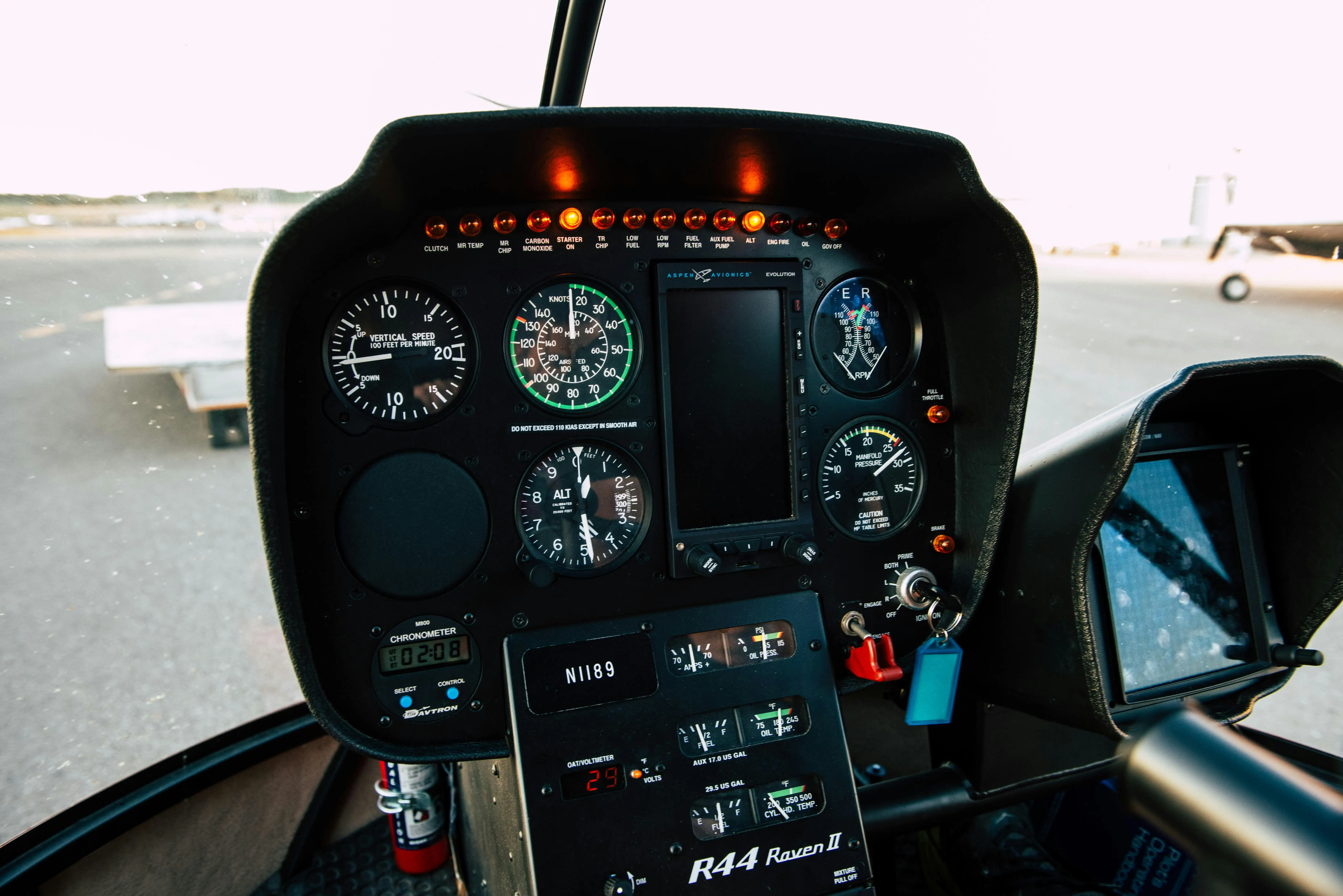
USATS operates a specialized rotorcraft training fleet featuring the Schweizer S300 and the Robinson R44. Working with a dedicated helicopter training pilot instructor in the three-bladed Schweizer S300 teaches nuanced hover control and autorotations, while the Robinson R44 provides glass-cockpit avionics, speed, and payload capacity required by commercial touring and charter operations.
Yes. An introductory discovery flight puts you in the cockpit with a certified instructor, where you will take the controls, practice hover taxiing, and fly along the Space Coast. Every minute is officially logged in an FAA logbook and counts directly toward your license requirements. Read our First Helicopter Flight Lesson Guide for a detailed walkthrough.
Full-time students training 4 to 5 days per week can complete their Private through Commercial Pilot rotorcraft certificates in approximately 10 to 14 months. Part-time students completing 1 to 2 lessons per week generally take between 18 and 24 months. Training in Central Florida ensures over 300 flyable days each year, drastically reducing weather delays.
Private helicopter pilots require at least a third-class FAA medical certificate issued by an Aviation Medical Examiner (AME). Commercial rotorcraft pilots require a second-class medical certificate, and airline transport pilots require a first-class certificate. We recommend completing your medical examination before starting intensive flight lessons.
Graduates with commercial rotorcraft licenses work across diverse sectors including emergency medical services (EMS), law enforcement, aerial firefighting, offshore energy logistics, powerline inspection, executive charter, and flight instruction. Many pilots build their initial 500 to 1,000 flight hours as flight instructors at USATS before stepping into turbine commercial roles.
Yes. USATS trains pilots from more than 120 countries and is authorized under federal law to issue Form I-20 for M-1 student visas. Our team assists with TSA Alien Flight Student Program (AFSP) fingerprinting, on-site FAA testing, and visa documentation.